London Climate & Capital Conference

Event recap and takeaways
Market dynamics
- Demand for climate and physical risk data is accelerating, not slowing. Leading investors are actively building, with growing interest in adaptation data across the full spectrum of assets, including residential and commercial real estate. The backdrop of adaptation and resiliency debate was the insurability crisis that climate risk is creating that may be looming in the US and abroad.
- The focus has shifted from long-horizon scenarios to near-term signals. Investors increasingly want data that drives decisions within a 1-3 year window, not just long-range planning.
- Execution, not ambition, is now the test. The market has moved from setting targets to delivering, with materiality increasingly understood at the sector level rather than in broad terms.
- Depth beats breadth. Being a generalist is no longer enough - to compete, firms need to get quantitative about where they actually create value and focus there.
Regulation and policy
- Regulatory fragmentation is a growing operational challenge. Investors are navigating transatlantic divergence, EU/UK dynamics, and climate disclosure uncertainty all at once.
- Political cycles are clouding transition planning. It’s increasingly hard to see past near-term election cycles. Climate alliance membership has declined year over year, and firms are having to factor qualitative political variables into portfolio decisions.
Data and technology
- Nature and physical risk are converging into integrated frameworks. Natural capital evaluation is moving into mainstream risk processes. Nature data has come a long way, particularly through location-specific analytics, and is now mature enough to use as a real engagement tool.
- Geospatial data is expanding into compliance. Work like Space Intelligence’s deforestation and land-use mapping for coffee, driven by EUDR, shows geospatial analysis moving beyond operational risk into regulatory use cases - one to watch closely.
Sector focus
- Social impact is on corporates’ radar. Several corporate attendees raised community resilience as a growing dimension of their sustainability work alongside traditional climate metrics.



Reports launched
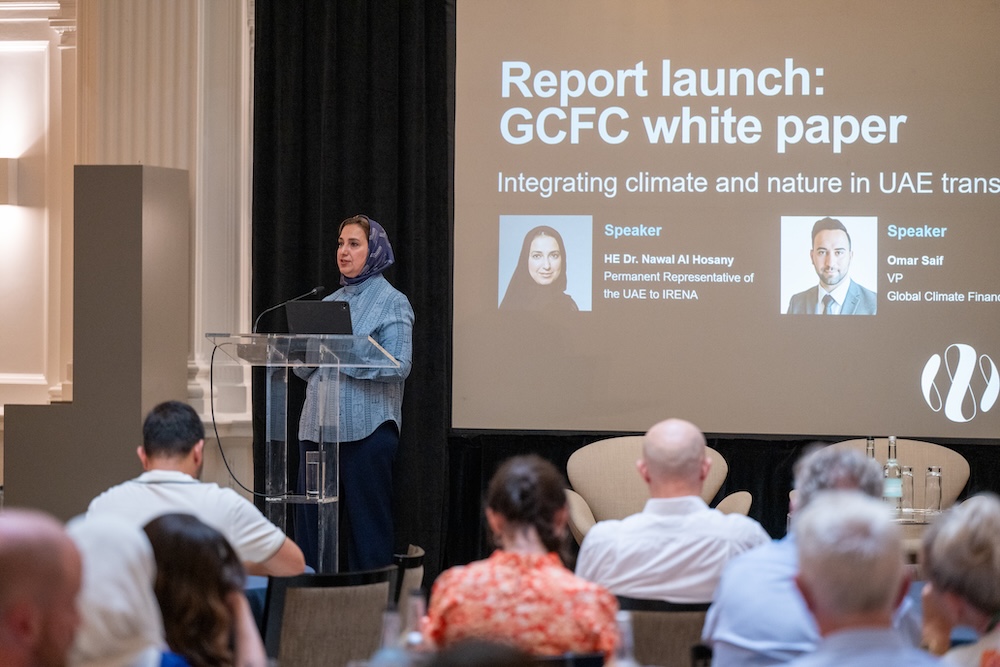
Global Climate Finance Centre - UAE TNFD nature finance paper
We were proud to host the launch of this new publication, authored by GCFC in its capacity as UAE TNFD Convenor, with geospatial analysis from our partners at NatureAlpha. It explores how UAE institutions can integrate climate and nature into transition finance, including a geospatial assessment of more than 2,000 UAE-located assets. Worth a read for anyone focused on nature finance.
CDP Disclosure Dividend 2026
CDP recently published this report, with contributions from ICE Climate, making the data-backed case that climate disclosure drives better financial outcomes. If you haven’t read it yet, it’s worth your time.
Prepare for more questions about extreme heat and chronic hazards
The heatwave in London brought chronic hazards into sharp focus - trains canceled, events canceled, infrastructure strained across the city. Our 2023 research found that even under a best-case scenario, chronic heat and drought stress could displace over 800,000 people in the U.S. alone and put more than $7 billion in municipal debt at risk. The heatwave is a reminder to pay closer attention to these chronic risks. We expect more conversations and questions on this topic in the coming months, so a few recent papers can provide a refresher:
Productivity losses due to extreme heat
Models the impact of rising heat on labor productivity and GDP, finding that lower-income regions face disproportionately larger economic losses.
Heat and human mortality
Projects excess mortality from rising temperatures among the most vulnerable populations, showing how income level and climate exposure shape risk.
Agricultural productivity and climate change
Estimates how rising heat exposure during growing seasons could reduce yields for major global crops over the coming decades.