July 2026 wildfires in Spain and France: exposure and projected loan delinquency
Aug. 4, 2026
Key takeaways
- Spain and France are facing unprecedented wildfire activity. ICE Climate's wildfire delinquency model projects significant increases in three-month+ delinquency rates for exposed properties, particularly in Spain.
- European mortgage structures mean wildfire credit risk is likely to concentrate on bank balance sheets, while the nature of Spanish and French loans and portfolio retention keep losses with homeowners and lenders - making geographic concentration a material portfolio risk.
- As wildfire risks intensify across Southern Europe, ICE Climate combines granular risk analysis and property-level delinquency modeling to help banks identify, quantify and manage wildfire exposure before losses materialize.
Spain and France are facing unprecedented wildfire activity. The Burgohondo fire on the Ávila and Madrid border is the largest wildfire ever recorded in Spain, at more than 50,000 hectares.1 In France, a fire near Bordeaux burned more than 42,000 hectares by 27 July and forced the evacuation of the Cap Ferret peninsula.2 Over 32,900 buildings fall inside the fire footprints (13,744 in Spain, 19,179 in France), including 77 identified corporate asset locations. Agricultural exposure to date is relatively low, with only ~0.2% and less than ~0.05% of the EU’s total olive and maize production respectively, exposed to the fires.3
Residential mortgage and property exposure presents one of the most significant financial risks. ICE Climate's wildfire delinquency model projects significant increases in three-month+ delinquency rates for exposed properties — particularly in Spain, where increases are expected to be substantial. Since wildfire damage is often uninsured, losses will fall primarily on homeowners and lenders.4
Mortgage delinquency uplift projections
ICE Climate’s econometric mortgage delinquency model estimates the increase in expected three-month+ delinquency rates for residential homes sitting inside the fire footprints. The complete research paper describing the delinquency model, built using data on millions of records on U.S. residential mortgage performance, can be found here.
On average, about 40% of buildings in each exposed postal code in Spain are located within the wildfire footprints, with ~32% average modelled delinquency uplift. The highest impact was seen in Piedralaves, at 98.4% of the postal code in the wildfire perimeter and 79.4% projected delinquency uplift. France also saw significant impacts, with an average of 22% of buildings in nearby postal codes located within wildfire footprints, with 18% projected delinquency uplift. The two exposed regions are described in more detail below.5
Spain: Sierra de Gredos
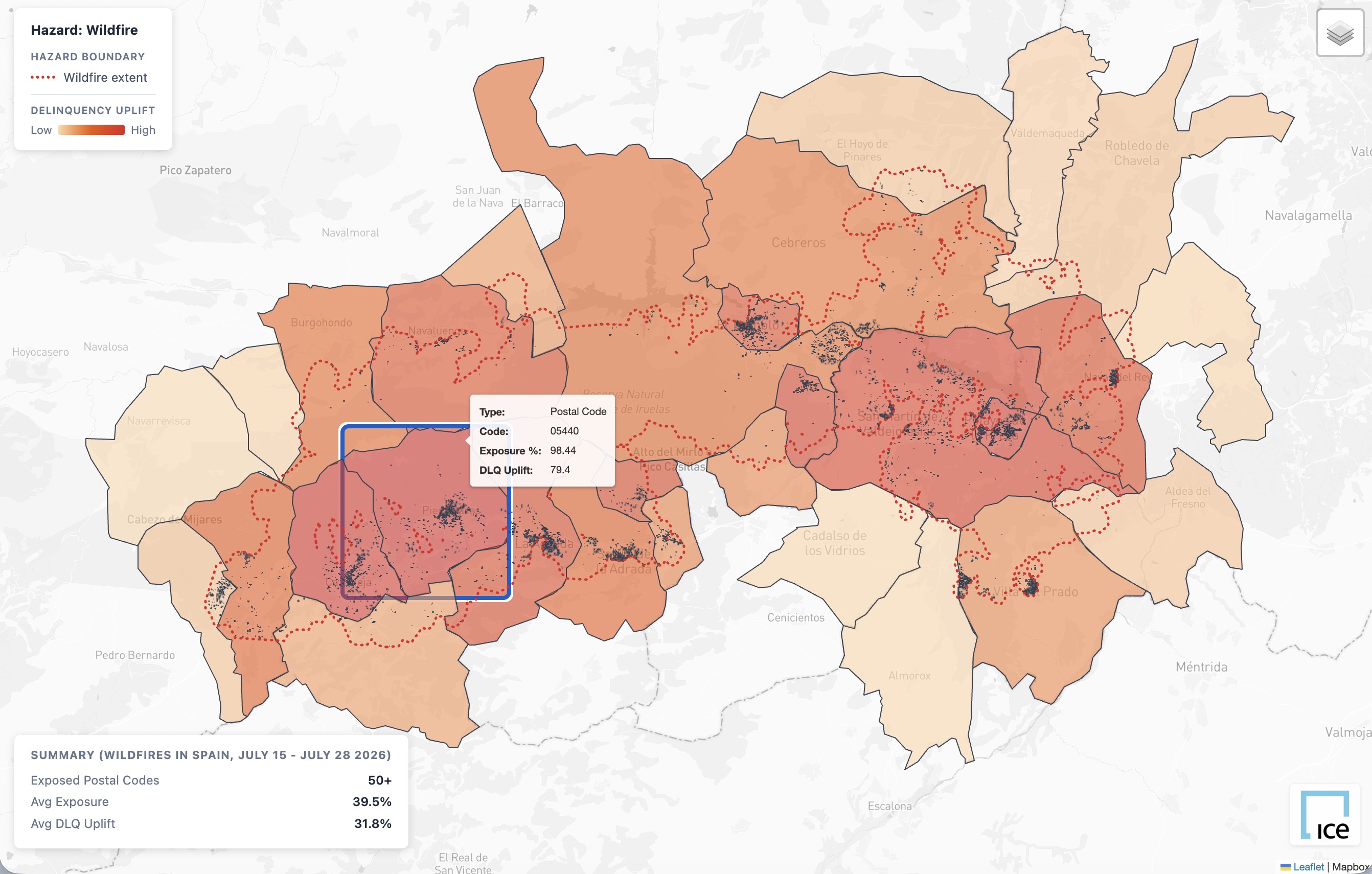
Figure 1. Wildfire extent and modelled mortgage delinquency uplift, Sierra de Gredos, Ávila province, Spain. The postal code 05440 (Piedralaves) is highlighted above, where ICE Climate forecasts a 79.4% increase in three-month+ mortgage delinquency rates from wildfire exposure. Rooftops are shown as small polygons (visible as dots). Source: ICE Climate
In Spain, the Consorcio de Compensación de Seguros, the nation’s state-backed catastrophe compensation fund, does not cover wildfire property damage, and full-recourse mortgages keep the borrower liable for the debt even after the property is lost.6 Any residual credit risk then stays on the lender’s balance sheet rather than moving to investors, because covered bonds keep the issuing bank liable rather than transferring risk via securitization.7 Despite the size of the fire, the exposed postal codes represent a small part of the €485 billion in total outstanding residential mortgage debt across Spain.8
France: Landes de Gascogne
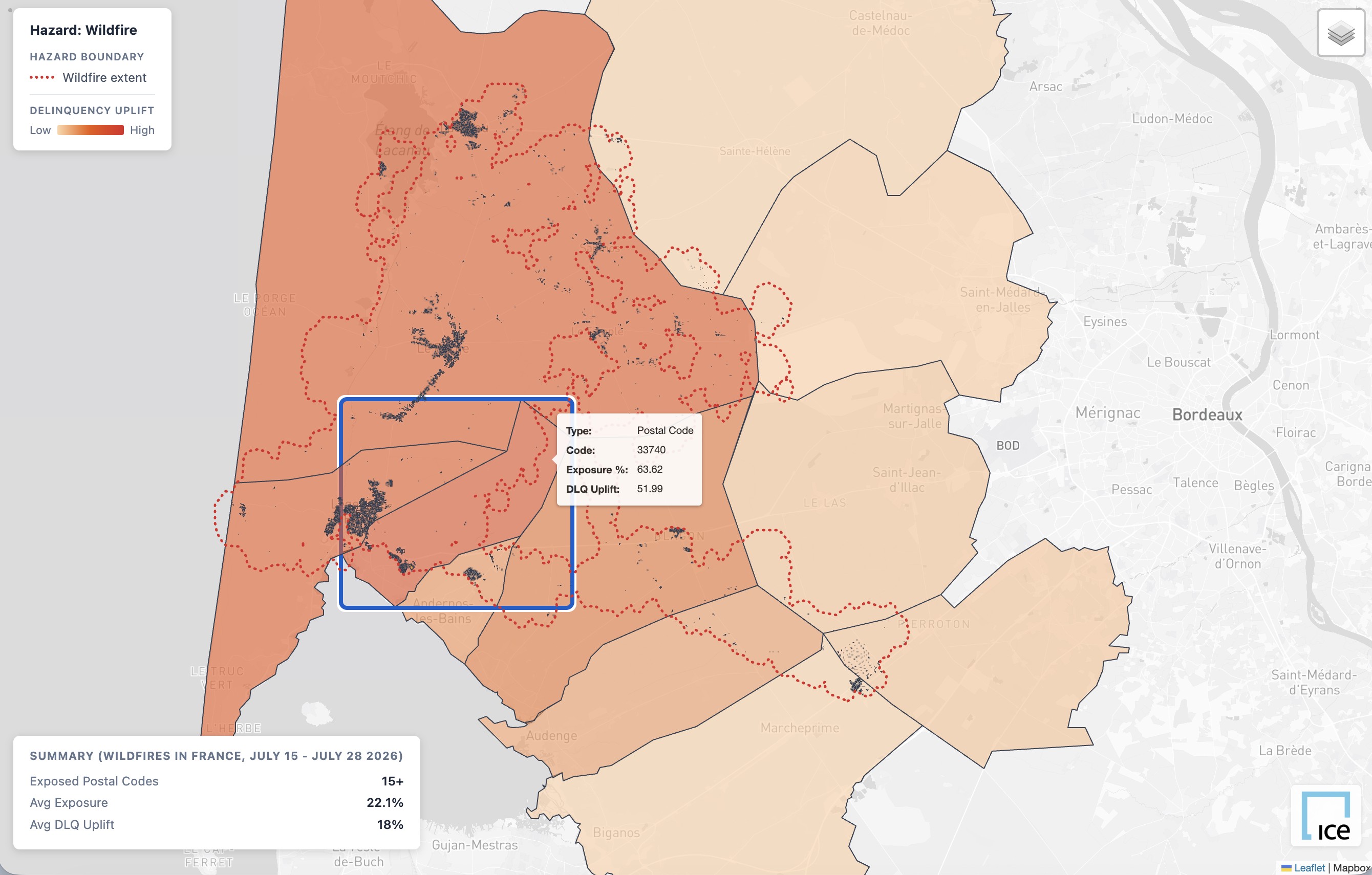
Figure 2. Wildfire extent and modelled mortgage delinquency uplift, west of Bordeaux, France. The postal code 33740 is highlighted above, where ICE Climate forecasts a 52% increase in three-month+ mortgage delinquency rates from wildfire exposure. Rooftops are shown as small polygons (visible as dots). Source: ICE Climate
In France, losses are generally absorbed before they reach the lender: wildfire is a standard peril within widely held multi-risk home insurance, and many home loans carry a third-party guarantee (Crédit Logement, Caisse d'Assurances Mutuelles du Crédit Agricole, or Compagnie Européenne de Garanties et Cautions) that meets a default before the lender is affected, with any residual risk remaining on bank balance sheets rather than in securities.9
The bottom line
European mortgage structures mean wildfire credit risk is likely to concentrate on bank balance sheets, not in securitized bonds. Spanish covered bonds and full-recourse loans combined with French portfolio retention practices keep losses with homeowners and lenders — making geographic concentration a material portfolio risk.
As wildfire risks intensify across Southern Europe, ICE Climate combines granular risk analysis and property-level delinquency modeling to help banks identify, quantify, and manage wildfire exposure before losses materialize.
Want to learn more about ICE Climate?
To learn more about the unique insights ICE can provide at the intersection of climate risk and financial markets, contact us below.
1. CNN, “Spain and France wildfires stabilise but risks remain”, 29 July 2026.
2. France 24, coverage of the 2026 Gironde wildfire, 28 July 2026.
3. ICE Climate exposure analytics: building, corporate-asset and agriculture layers, July 2026.
4. Morningstar DBRS wildfire commentary, July 2026; Allianz Research on the European insurance protection gap.
5. ICE Climate exposure and delinquency statistics and estimates are based on exposure as of 28 July 2026, measured at postal-code level; the snapshot predates the largest fire advances, so the figures are an early-window view.
6. Consorcio de Compensación de Seguros, scope of cover for extraordinary risks, under which wildfire damage to property is met by private fire insurance rather than by the Consorcio; Spanish Civil Code, full-recourse liability of mortgage borrowers, per Uría Menéndez commentary, 2026.
7. On the dual-recourse structure of covered bonds, which keeps the issuing bank liable and does not transfer credit risk to investors in the way a securitization does; European Covered Bond Council. The point applies to cédulas hipotecarias in Spain and to obligations foncières and obligations à l’habitat in France.
8. European Mortgage Federation, Hypostat 2025: outstanding residential mortgage lending of about €485 billion in Spain and about €1.3 trillion in France.
9. Treatment of wildfire as a standard fire peril within French multi-risk home insurance, industry commentary, 2025 to 2026; DBRS Morningstar, on the use of third-party guarantees (Crédit Logement, CAMCA, CEGC) in French home loans.
Limitations
This material contains information that is proprietary property of Intercontinental Exchange, Inc. and/or its affiliates (“ICE Group”), and is not to be published, reproduced, copied, modified, disclosed or used without the express written consent of ICE Group.
This material is provided for informational purposes only. The information contained herein is subject to change without notice. Nothing herein should in any way be deemed to alter the legal rights and obligations contained in agreements between ICE Group and their respective clients relating to any of the products or services described herein. Nothing herein is intended to constitute legal, tax, accounting, investment or other professional advice.
ICE Group makes no warranties whatsoever, either express or implied, as to merchantability, fitness for a particular purpose, or any other matter. Without limiting the foregoing, ICE Group makes no representation or warranty that any data or information supplied to or by it are complete or free from errors, omissions, or defects and nothing contained herein should constitute any form of warranty, representation, or undertaking.
All feature values included in the products and services described herein are estimates, including those values that are derived using data provided by other data providers as well as forecasts of expectations of change. Such estimates are based upon information available to ICE Group at the time of calculation, are provided as is, and should be treated as estimates and forecasts with potentially substantial deviations from actual outcomes, regardless of whether such features are explicitly described in any data dictionary, methodology, or definition as estimates or forecasts.
Where required, the features are developed using a set of methodologies designed to prevent any form of reverse engineering or geographic identification from the features in isolation or in combination, but still provide potentially meaningful insights regarding the underlying securities.
ICE Group is not registered as a nationally registered statistical rating organization, nor should this document be construed to constitute an assessment of the creditworthiness of any company or financial instrument. Analytics available through the service are meant to be generally indicative of overall feature sets and should not be considered an analyst’s opinion of the underlying investability of a particular location or security. These analytics are designed to help summarize and aggregate large amounts of information, but will therefore not capture the nuances, or the “full picture” of any entity’s features. No part of this service should be construed as providing investment advice. Listing or linking to sources in attribution does not indicate endorsement by ICE Group of the data source, nor does it reflect an endorsement by the data provider of the products or services described herein.
GHG emissions information available is either compiled from publicly reported information or estimated, as indicated in the applicable product and services.
ICE Data Services refers to a group of products and services offered by certain Intercontinental Exchange, Inc. (NYSE:ICE) companies and is the marketing name used for ICE Data Services, Inc. and its subsidiaries globally, including ICE Data Indices, LLC, ICE Data Pricing & Reference Data, LLC, ICE Data Services Europe Limited and ICE Data Services Australia Pty Ltd. ICE Data Services is also the marketing name used for ICE Data Derivatives, Inc., ICE Data Analytics, LLC, and certain other data products and services offered by other affiliates of Intercontinental Exchange, Inc. (NYSE:ICE).
Trademarks of ICE Group include: Intercontinental Exchange, ICE, ICE block design, NYSE, ICE Data Services, ICE Data and New York Stock Exchange. Information regarding additional trademarks and intellectual property rights of ICE Group is located at https://www.ice.com/privacy-security-center/terms-of-use. Other products, services, or company names mentioned herein are the property of, and may be the service mark or trademark of, their respective owners.
© 2026 Intercontinental Exchange, Inc.
Related resources
- Learn moreICE Climate
Quantifying climate risk and opportunities in fixed income and real estate.
- Learn moreICE Climate Analytics for Municipal Debt
Climate risk has the potential to upend the municipal market.
- Learn moreHow municipal bond insurers underwrite for decades of extreme weather risk
A conversation with Jamie Shilling, Deputy Chief Credit Officer at BAM Mutual, on long-term natural hazard risk.